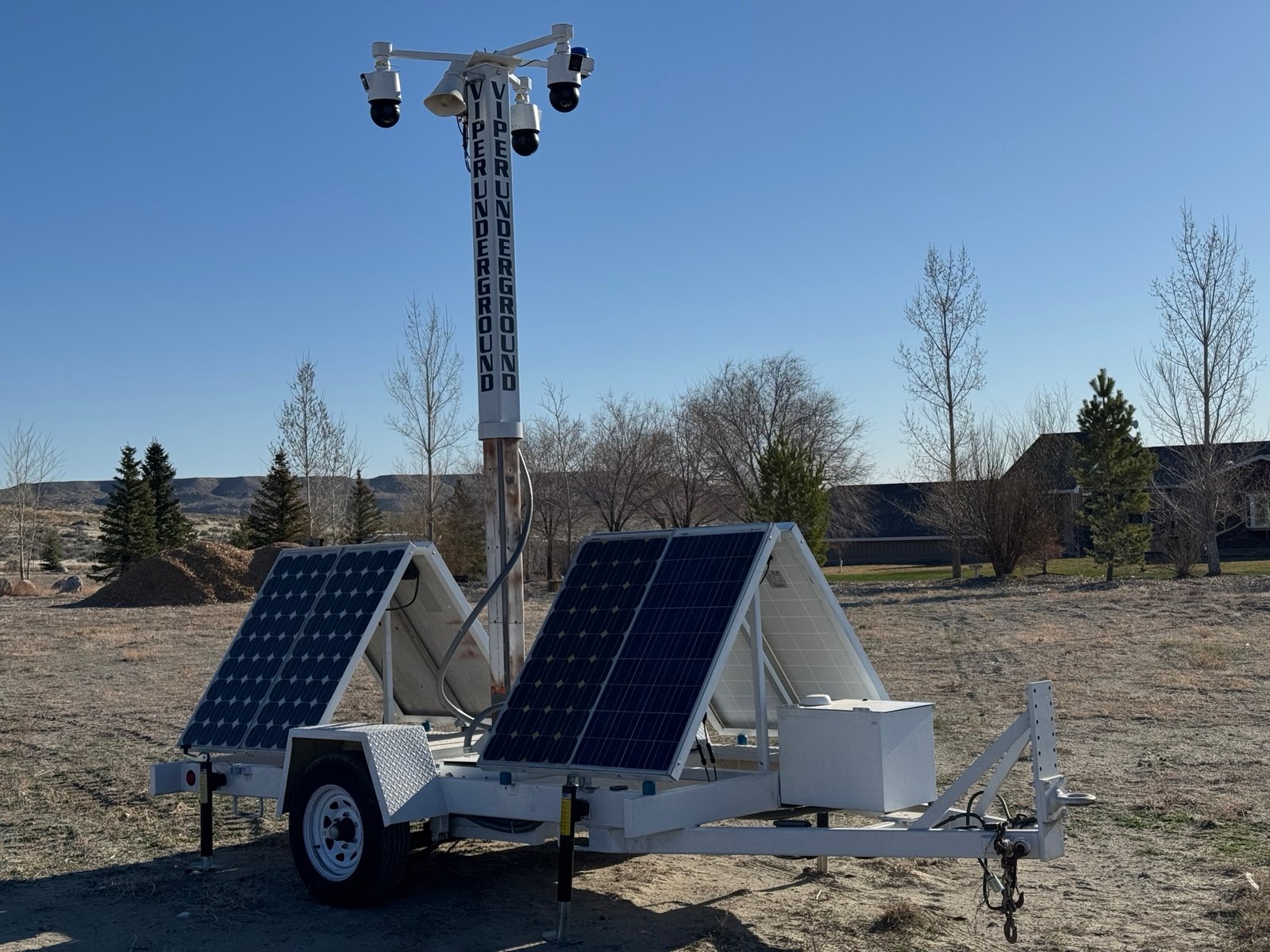
Solar Power for Security Cameras: How to Match Your System to Real-World Power Needs
Posted in :

Running security cameras off solar sounds straightforward — until your system goes dark at 2 AM in December. The difference between a system that works and one that fails overnight comes down to one thing: matching your solar setup to your actual equipment draw. This guide breaks down exactly how to do that.
Table of Contents
- Why Power Matching Matters
- Understanding Camera Power Draw
- PTZ vs Fixed Cameras: Power Comparison
- Nighttime Operation and IR Load
- Seasonal Solar Considerations
- How to Calculate Your Battery Needs
- Solar Panel Sizing
- Recommended System Configurations
- FAQ
Why Power Matching Matters — And Where Most People Get It Wrong
The most common mistake in solar-powered security installations is sizing the panel to the camera spec sheet — and ignoring everything else. Real-world power consumption depends on:
- How many hours of darkness you need to cover
- Whether the camera uses IR night vision (it draws significantly more at night)
- Camera type — PTZ motors consume far more than fixed lenses
- Time of year — winter means shorter days, more reliance on stored battery power
- Temperature — cold weather reduces battery efficiency
Get any of these wrong and you end up with a camera that records sunrise beautifully and misses every overnight incident.
Understanding Camera Power Draw
Security cameras are rated in watts (W) or milliamps (mA). Most spec sheets give you a maximum draw, but actual consumption varies based on activity. Here are typical ranges:
- Fixed IP cameras (no IR active): 3–7W
- Fixed IP cameras (IR active, night mode): 7–12W
- PTZ cameras (idle): 8–15W
- PTZ cameras (moving, IR active): 15–30W
- NVR (4-channel): 10–20W
- NVR (8-channel): 18–35W
If you are powering the NVR off solar as well — which is common in off-grid installations — that load must be included in your calculation. Many installers forget this entirely.
PTZ vs Fixed Cameras: Power Comparison
PTZ (Pan-Tilt-Zoom) cameras are the biggest power variable in any solar system. When a PTZ motor engages — especially during auto-patrol or event-triggered movement — current draw can spike to 2–3x the idle rating.
| Camera Type | Idle Draw | Active/IR Draw | 12-Hour Night Consumption |
|---|---|---|---|
| Fixed Dome (no IR) | 4W | 4W | 48Wh |
| Fixed Dome (IR active) | 5W | 10W | 120Wh |
| PTZ (idle overnight) | 12W | 12W | 144Wh |
| PTZ (active patrol + IR) | 12W | 25W | 300Wh |
The takeaway: a single PTZ on active patrol overnight can consume as much power as four fixed cameras. If your site uses PTZ cameras, plan your battery bank accordingly.
Nighttime Operation and IR Load
Infrared illuminators draw significant current. When a camera switches to night mode, it activates its IR LEDs — and that can double the power draw instantly. For solar systems, this is the critical load window because it aligns exactly with the period your panels are not producing.
Key considerations for nighttime power planning:
- IR range affects draw: A camera rated for 100ft IR range will draw substantially more than one rated for 30ft.
- Motion-triggered IR vs always-on: Some cameras allow IR to activate only on motion detection. This can meaningfully reduce overnight consumption.
- Color night vision cameras: These use a white-light illuminator instead of IR. Draw is similar, but the white light is more noticeable — something to factor into installation planning.
Seasonal Solar Considerations: The Winter Problem
Solar power is not consistent year-round — and this catches a lot of installers off guard. Two things happen in winter that compound your power challenge:
- Shorter days = fewer peak sun hours. A location that gets 6 peak sun hours in June may get only 2–3 in December. Your panels produce a fraction of their summer output.
- Longer nights = more battery drain. You are asking the battery to carry the load for 14–16 hours instead of 8–10.
This means a system sized for summer will likely fail in winter. The correct approach is to size for your worst-case month — typically December or January depending on your latitude.
| Season | Avg Peak Sun Hours (US) | Avg Night Length | Battery Dependency |
|---|---|---|---|
| Summer | 5–7 hrs | 8–9 hrs | Low |
| Spring / Fall | 4–5 hrs | 11–12 hrs | Moderate |
| Winter | 2–3 hrs | 14–16 hrs | High — critical sizing window |
How to Calculate Your Battery Needs
Follow this formula to determine the minimum battery capacity for your system:
- Total system wattage: Add up all cameras + NVR. Example: 2 fixed cameras at 10W each + 1 PTZ at 20W + NVR at 15W = 55W total
- Hours of darkness (worst case): Use your longest night of the year. For most of the US, plan for 16 hours.
- Daily energy needed: 55W x 16 hrs = 880Wh
- Add autonomy buffer (cloudy days): Multiply by 1.5-2 for 1-2 days of cloud cover. 880Wh x 2 = 1,760Wh
- Account for battery depth of discharge (DoD): Lead-acid: use only 50% of rated capacity. LiFePO4: use up to 80%. For LiFePO4: 1,760Wh / 0.8 = 2,200Wh minimum battery capacity
Solar Panel Sizing
Once you know your battery needs, work backwards to size the panel:
- Daily energy to replenish: From the example above, 880Wh per day.
- Divide by worst-case peak sun hours: 880Wh / 2.5 hrs = 352W of panel minimum
- Add efficiency losses (wiring, charge controller, temperature): Multiply by 1.25. 352W x 1.25 = 440W recommended panel capacity
For this example system (2 fixed cameras + 1 PTZ + NVR), you would need roughly 400-450W of solar panels to operate reliably year-round in a northern US climate.
Many off-the-shelf solar camera kits include a 20W or 40W panel. Those panels are adequate only for a single, fixed camera with no NVR. Do not let marketing photos of “solar-powered systems” lead you to undersize your installation.
Recommended System Configurations
Configuration 1: Single Fixed Camera, Remote Location
- Camera: 1 x fixed IP dome, 10W with IR
- Panel: 50-80W
- Battery: 100Ah LiFePO4 (12V)
- Charge controller: 10A MPPT
- Best for: Gates, driveways, equipment sheds
Configuration 2: Small Multi-Camera System (No PTZ)
- Cameras: 4 x fixed IP cameras, ~10W each
- NVR: 4-channel, 15W
- Panel: 200-250W
- Battery: 200Ah LiFePO4 (12V) or 100Ah 24V
- Charge controller: 20-30A MPPT
- Best for: Small yards, construction sites, rural outbuildings
Configuration 3: PTZ + Fixed Camera Mixed System
- Cameras: 2 x fixed IP at 10W + 1 x PTZ at 25W average
- NVR: 4-channel, 15W
- Panel: 400-500W
- Battery: 300Ah LiFePO4 (12V) or 150Ah 24V
- Charge controller: 40A MPPT
- Best for: Larger properties, remote commercial sites
Frequently Asked Questions
Can I just buy a solar-powered camera kit and call it done?
For a single camera covering a small area, yes — many all-in-one kits are well-designed for that use case. But for multi-camera systems or sites with PTZ cameras, kits almost always undersize both the panel and battery for real-world overnight and winter operation.
What happens when the battery runs out overnight?
The camera and NVR shut down. You lose recording until the battery recharges the following day. In a properly sized system this should never happen — but it is the most common complaint about DIY solar installs.
Does camera resolution affect power draw?
Slightly, but not significantly. The sensor, IR illuminators, and motor (on PTZ) are the dominant power consumers — not the resolution of the image processor. Going from 2MP to 4MP adds a watt or two at most.
How do I handle a PTZ on auto-patrol?
Treat it as if it is always at maximum draw for sizing purposes. In practice it may average less, but designing for worst case gives you a reliable system. If power is very constrained, consider limiting patrol schedules to daytime only and letting the PTZ sit idle overnight.
Is it better to run 12V or 24V systems?
24V systems are more efficient for larger installations — lower current means less heat and thinner wiring. For single-camera setups, 12V is simpler. Once you exceed 200W of panels or 200Ah of battery, consider moving to 24V.
Recommended Kit
If you are building or upgrading a solar-powered camera system, the right equipment matters as much as the right math. Browse our recommended cameras, NVRs, and PoE equipment at cctvtrainer.com/shop, or contact Roylance Consulting for a custom system design for your property.
Need help choosing between PTZ and fixed cameras for your site? Get in touch — we size systems every day.
